After a very healthy interim results season for the portfolio in July and August, the fundamental news-flow was much lighter in September. The market was instead dominated by big-picture themes – the price of oil, rising bond yields and the AIi datacentre build-out.
In the world of company fundamentals, we have been very busy meeting companies, analysts and experts. As mentioned last month, we are seeing a great number of interesting opportunities across our multi-cap universe of UK quality companies and have recycled the fund’s Rotork and Intertek holdings (both of which received recommended offers earlier in the year) into four new positions. They are DiscoverIE, Avon Technologies, Greggs and XPS Pensions. We also added another two new positions at the beginning of October, which are covered later in this investment view.
The free cash flowii valuation of the portfolio remains highly appealing, and forecasts for aggregate growth remain good – revenue growth of +5%, operating profit growth of +8%, and double-digit earnings growth are forecast for 2026.
Third quarter results season has begun, and we discuss some recent results in the company round-up section below.
Self-Funding Cash Machines for the next Market Phase
Before we get into company specifics, it’s worth highlighting some early signs of distress starting to emerge in global credit markets, suggestive of the fact that we are increasingly late in the credit cycle. This chart of CCC junk bond spreadsiii is a good example:
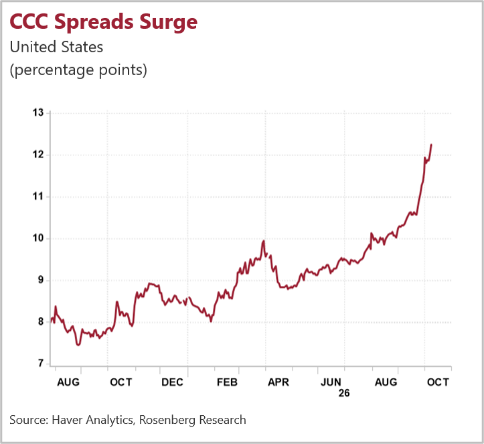
CCC bonds are the marginal borrowers in the credit system. They depend on capital markets staying open, so they feel any tightening first.
With this development in mind, it is worth reiterating the repeat-purchase cash generation, the strong and clean balance sheets, and the self-funding characteristics that the Evenlode Income portfolio holdings possess. These are all qualities that the market has cared very little about over the last three years, but are qualities that become increasingly cherished when bad debts rise and liquidityiv and credit supply begin to dry up. To be a little more specific about some of the common characteristics of portfolio holdings:
1) High and resilient free cash flow: The bulk of the portfolio’s cash flow comes from repeat-purchase business models.
2) Low Leveragev and clean balance sheets: debt levels in the portfolio are low, as is total leverage. Quality companies generate a high return on invested capital (ROIC)vi, so they don't need to employ leverage in their business models to generate an attractive return on equity for their shareholders. Low-return businesses are inherently reliant on leverage to generate attractive returns on equity. The balance sheets of quality companies tend also to be clean and simple.
3) Self-funding: we invest in businesses with durable competitive advantages that can grow in a capital efficient way - this is our definition of ‘quality’. These characteristics lead to reliable conversion of earnings to free cash flow and - therefore – the ability to consistently fund both their operations and growth investment from self-generated funds. When equity and credit markets start to feel the strain, this type of business model is not reliant on the kindness of strangers for its funding.
Company Updates
To finish this investment view, we will briefly cover some recent news-flow from some recent additions and existing holdings in the portfolio, as well as the two new holdings we have added in early October.
Recent additions: strong delivery
The four new holdings we added over the summer have all been amongst the earliest to release results in the third quarter season. For more detail on the investment case for these stocks, please refer to last month’s investment view, in which they were discussed in more detail.
Avon Technologies: The company released a strong trading update last week and also held a capital markets day. Revenue growth for the full year is expected to be approximately +12.5%, and profit margins continue to rise. New medium-term targets also led to upgraded earnings and free cash flow forecasts for the next three years. The company is a strong global leader in CBRN equipment and military helmets - an attractive market given the high threat environment in the world today. We think the Return-On-Invested-Capital (ROIC) focused management team are very good, and the potential for compounding free cash flow growth is highly appealing. The ROIC has risen from 9% to more than 20% in the last three years, thanks to improved commercial and operational execution under new management. Despite the rise in the share price last week, based on management targets the stock is still trading on a free cash flow yieldvii of over 6% on average for the next three years.
DiscoverIE: The company released a trading update this week, also leading earnings upgrades. Growth is beginning to accelerate, with organic revenue growthviii up +8% over the last sixth months. Order book momentum is strong, up +30% year-on-year. DiscoverIE is a proven compounder and a beneficiary of many of the big structural themes in the world today, with the following areas making up 80% of revenue: industrial automation and connectivity, security and defence, renewables, electrification of transportation, and medical. Management’s ambition remains to roughly double earnings every five years, through a combination of decent organic growth and disciplined bolt-on acquisitions. The free cash flow yield is 5.4%.
Greggs: Greggs reported solid trading, also leading to earnings upgrades. Despite the heatwave, revenue grew +7.7% in the latest quarter, up +7.4% year-to-date. As discussed last month, Greggs is very well invested, and with capital expenditure normalising the company is moving into a highly cash generative phase, with all free cash flow available to return to shareholders via ordinary dividends, special dividendsix and share buy-backs. Despite the beginnings of a share price recovery over recent weeks, the company still trades on a free cash flow yield of 8.2%.
XPS Pensions: XPS released a trading statement this week, also leading to earnings upgrades. Revenue grew +12% for the latest six months. Whilst much of XPS’s revenue is highly recurring, the company is also benefiting from the ongoing change and regulatory complexity within the UK pension sector. The free cash flow yield remains highly attractive at 8.0%.
Existing holdings
Clarkson: benefiting from a multi-polar world
Clarkson released a positive trading statement last week, leading to +18% earnings upgrades. As with Avon Technologies, the shift to a multi-polar world - and the complexities that it brings - are helpful for the company. Clarkson are busy helping customers re-route freight routes and build increasing resilience into their supply chains. We continue to view Clarkson as the unparallelled market leader in the global ship-broking industry, and well placed to keep taking steady market share in the years ahead. The more complex the environment is, the more helpful Clarkson’s irreplicable network and unique datasets become. This quote from management helps illustrate this point within its energy vertical: if you are Shell, you’re moving LNGx, crude oil, chemicals and offshore energy markets. We are number one in all of these markets. If you are a competitor and only doing crude oil you just aren’t as critical to Shell as we are.
Informa: building the global leader in business-to-business events
Last week Informa announced plans to separate its academic publishing business, Taylor & Francis (T&F), and expand further in business-to-business (B2B) events through the £2.24bn acquisition of Clarion from Blackstone. Once the separation is complete, Informa will have largely finished its transformation from a portfolio of academic journal, conference and business information brands into a focused B2B live events group.
Clarion is a unique asset with over 100 B2B event brands operating globally in growth categories. It complements Informa's portfolio well. It gives Informa scaled entry into three high-growth categories (electronics, defence and security, and gaming), and its technology and energy franchises can be marketed jointly with Informa's own events. At the acquisition presentation management highlighted the opportunity to take Clarion events into new geographies using Informa's global platform. After the deal, Informa's B2B live events business will generate more than £4.2bn of revenue across around 1,000 brands, with management targeting group organic growth of 7%+.
Following Iran-related share price weakness earlier in the year, we adding to our position in Informa. The shares are trading at an 8% free cash flow yield, which is very attractive given Informa’s leading position in a highly profitable structurally growing industry. B2B events have durable economic moatsxi built on network effectsxii between exhibitors and attendees. The leading events in each industry are essential for corporate marketing, particularly for small and medium sized businesses, giving them access to customers internationally. Informa is the global leader in events, more than 3x larger than RELX, the next largest. Below Informa and RELX the industry is highly fragmented, with Clarion the third largest.
We see this as a logical strategic step for Informa. While execution will be key, Informa has built a strong global platform and successfully integrated larger businesses in the recent past. Going forward there are few large-scale event acquisition opportunities left for Informa. Based on our recent meeting with management, we expect the focus to shift to organic growth, complemented by smaller niche bolt-ons. This supports an outlook of strong organic growth, increasing ROIC, and significant shareholder returns. Informa also this week confirmed full year 2026 guidancexiii for organic revenue growth of 6% and double-digit Earnings-Per-Share (EPS)xiv growth.
New Positions
As mentioned, we initiated two new positions in early October. Both represent approximately 1% of the fund. We discuss Fever-Tree below and will discuss the second next month – a niche FTSE 250 industrial compounder that brings more interesting diversification to the portfolio.
Fevertree
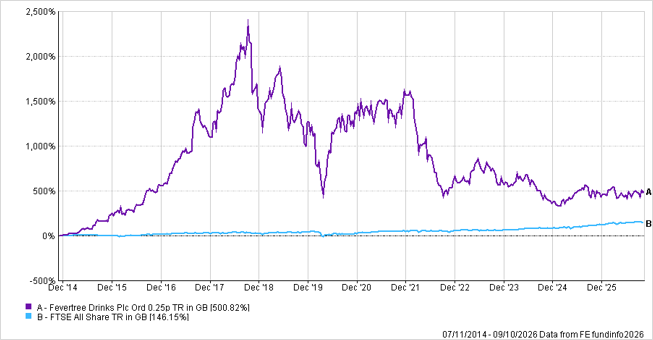
Fever-Tree has been in the fund’s investable universe for approximately a decade, but in the past the lack of dividend and free cash flow yield appeal has kept the stock out of the portfolio.
The graph above tells most of the story. Listed in November 2014, the stock spent the first four years of its publicly-listed life as a stock market darling – a premium mixer brand with a premium stock valuation to go with it. The company drove tremendous growth within its home UK market, as gin became the thing to drink in the UK during the mid-2010s. ‘Peak gin’ was then reached in the 2018-2020 period. The company subsequently experienced margin pressure during the input cost inflation of 2022 – squeezed by a combination of soaring glass costs and inadequate (but now resolved) hedging arrangements. This combination of factors, combined with a weak consumer environment, have led to a savage devaluation over the last seven years.
We have been checking in regularly on the investment, and this month brought the position into the portfolio, for five key reasons:
1) Brand strength: Fever-Tree represents a great British product – up there with a Greggs sausage roll, a Burberry trenchcoat, a Howdens kitchen, or a Space Marines miniature. Fevertree’s premium mixers and non-alcoholic drinks have proven, reliable pricing powerxv. As a proof-point, Fever-Tree sees a surge of demand every Christmas in the UK - no host across the country would dare serve their mother-in-law any other mixer over the festive period. A relatively inexpensive little luxury, even in chastened times.
2) Diversification from tonic and the ‘mixer occasion’: Non-tonic drinks are about half of group sales, against roughly 10% before Covid, and in the first half of 2026 the UK returned to growth (+3%). Within that, non-tonics grew by +10% and ginger beer by around +30%.
3) The international opportunity: The US, in particular, is a significant near-term opportunity. Fever-Tree is the market leader in both US tonic and US ginger beer, but these categories are still underdeveloped. The 2025 partnership with Molson Coors has widened Fever-Tree’s US reach from around 80,000 accounts to 500,000. Molson Coors now owns 8.5% of Fever-Tree and has provided a profit guarantee for Fever-Tree’s US joint venture covering the 2026–30 period. Molson Coors are also taking on the manufacture and distribution of US products, which will lift margins and reduce working capital. Beyond mixers, US ginger ale is a large category that is poorly served by its incumbents, and alcoholic ready-to-drink cocktails offer further scope for growth.
4) Plenty of levers to pull: We think that Fever-Tree has plenty of potential levers to pull to create value for shareholders. One is simply distributing excess cash flow following the step-up in cash generation from next year. Dividend growth, special dividends and buy-backs are all available options. Another possibility, longer-term, would be another US-style strategic partnership in a region such as Latin America.
5) Valuation appeal: With a net cash balance sheet, a dividend yieldxvi of approximately 2.4%, and on our estimates a forward free cash flow yield of more than 6%, the valuation looks very modest for a brand with a long growth runway and clear strategic value. This value could be realised by a trade buyer if public markets fail to recognise it.
That’s all for this month! We will be back next month for a full round-up of portfolio results, once third-quarter results season is complete.
Hugh, Chris M., Ben P, Leon and the Evenlode team
15 October 2026
Important information
Evenlode has developed a Glossary to assist investors to better understand commonly used terms.
Market data is sourced from S&P Capital IQ, Financial Express Analytics and Bloomberg unless otherwise stated.
This document is not intended as a recommendation to invest in any particular asset class, security, or strategy. The information provided is for information purposes only and should not be relied upon as a recommendation to buy or sell securities. Prospective investors should seek independent financial advice.
This document has been produced by Evenlode Investment Management Limited (‘Evenlode’). Every effort is taken to ensure the accuracy of the data used in this document, but no warranties are given.
Investment commentary represents the opinions of the Evenlode team at the time of writing and does not constitute investment advice. Where opinions are expressed, they are based on current market conditions, may differ from those of other investment professionals and are subject to change without notice. Any forecasts provided are subject to change and are not guaranteed.
IFSL Evenlode Income is a sub-fund of the IFSL Evenlode Investment Funds ICVC. Full details of the Evenlode Funds, including risk warnings, are published in the IFSL Evenlode Investment Funds Prospectus and the IFSL Evenlode Investment Funds Key Investor Information Documents (KIIDs) which are available on request and at www.evenlodeinvestment.com.
The IFSL Evenlode Investment Funds are subject to normal stock market fluctuations and other risks inherent in such investments. The value of your investment and the income derived from it can go down as well as up, and you may not get back the money you invested. You should therefore regard your investment as long term.
The Evenlode philosophy and process creates a bias towards companies that meet our quantitative and qualitative requirements. As a result, the fund may have material differences in exposure in terms of style factors, industry sectors and geographies to the wider equities market and comparator benchmark. Over the short-term this may result in material underperformance in certain market conditions. As a focused portfolio of between 30 and 50 investments, IFSL Evenlode Income may carry more risk than a fund spread over a larger number of stocks. The funds have the ability to invest in derivatives for the purposes of efficient portfolio management (techniques used by investment managers to manage a portfolio in a way that aims to improve returns, reduce risk, or manage costs, without significantly changing the overall investment strategy or risk profile), which may restrict gains in a rising market. Investments in overseas equities may be affected by changes in exchange rates, which could cause the value of your investment to increase or diminish.
Past financial performance is not a reliable indicator of future results. Fund performance figures are shown inclusive of any reinvested income and net of ongoing charges and portfolio transaction costs unless otherwise stated. The figures do not reflect any entry charge paid by individual investors. Tax treatment depends on individual circumstances and may change in the future.
We believe that delivering real, durable returns over the long term can be best achieved by integrating environmental, social and governance (ESG) factors into our risk management framework as this ensures that all long-term risks are monitored and managed on an ongoing basis. In addition to reviewing ESG factors when making investment decisions, we engage with portfolio companies on a range of ESG-related issues (for example supply chain resilience, cybersecurity and remuneration, amongst other things). However, please note that the fund does not have a sustainability objective.
This document is neither directed to, nor intended for distribution or use by, any person or entity who is a citizen or resident of or located in any locality, state, country or jurisdiction where such distribution, publication, availability or use would be contrary to law or regulation. The sale of shares of the fund may be restricted in certain jurisdictions. In particular shares may not be offered or sold, directly or indirectly in the United States or to U.S. Persons, as is more fully described in the Fund's Prospectus.
FTSE® is a trademark of the relevant London Stock Exchange Group plc (“LSE Group”) companies and is used under licence. FTSE Russell is a trading name of certain LSE Group companies. All rights in FTSE Russell indices and data vest in the relevant LSE Group company. Neither LSE Group nor its licensors accept any liability for errors or omissions in the indices or data, and no reliance should be placed on this information. Redistribution of LSE Group data is prohibited without prior written consent. LSE Group does not promote, sponsor, or endorse the content of this communication.
Evenlode is a trading brand of Evenlode Investment Management Limited. Authorised and regulated by the Financial Conduct Authority, No. 767844. Investment Fund Services Limited (IFSL) is authorised and regulated by the Financial Conduct Authority, No. 464193.
Footnotes
-
AI (Artificial Intelligence): Technology that enables computers and software to perform tasks that normally require human intelligence, such as understanding language, recognising patterns, analysing large amounts of information, making predictions, and generating content. AI can help people work more efficiently by automating routine tasks and identifying insights from data.
-
Free Cash Flow (FCF): A measure of how much cash a company can generate over and above normal operating expenses and capital expenditure. The more FCF a company has, the more it can allocate to dividend payments and growth opportunities.
-
CCC Junk Bond spreads: loans to companies that investors believe have a relatively high risk of getting into financial trouble. Because of that risk, investors expect to be paid considerably more interest than they would receive from safer government bonds. A credit spread is the extra yield investors demand for owning a risky corporate bond rather than a much safer government bond of a comparable maturity.
-
Liquidity: The ease with which an investment can be bought or sold without affecting the price. If an investment is highly liquid, it can easily be sold without affecting the price and if an investment is illiquid, it cannot easily be sold without affecting the price.
-
Leverage: A measure of how much debt a company uses in its business. Companies with higher leverage may be able to grow more quickly, but they are also more exposed to rising interest costs and periods of weaker trading.
-
Return on Invested Capital (ROIC): Calculated as net operating profit divided by invested capital. A measure of how effectively a company uses the money it has invested to generate profits.
-
Free Cash Flow Yield: Free Cash Flow (FCF) per share divided by the current share price. A higher Free Cash Flow Yield implies a company is generating more cash that could be paid out as dividends and to reinvest into growth of the business.
-
Organic Revenue Growth: The percentage increase of sales generated from a company’s existing resources and operations. Excludes growth attributable to mergers and acquisitions and foreign exchange.
-
Special Dividend: A one-off dividend paid by a company in addition to its regular dividends. Special dividends are typically paid when a company has generated excess cash.
-
LNG: Liquified Natural Gas
-
Moat strength: Refers to a company's ability to protect its profits and market position from competitors over a long period of time. A company with a strong moat has advantages that are difficult for competitors to replicate, such as a well-known brand, patented technology, high switching costs, network effects, or a unique business model.
-
Network Effects: Where the value of a product or service increases when the number of people using it increases.
-
Full Year Guidance: A company's forecast of how it expects to perform financially over its current financial year. This may include expectations for revenue, profit, earnings or cash flow. Investors often compare actual results with guidance to assess whether a company has performed in line with expectations.
-
Earnings Per Share (EPS): A measure of company profitability, calculated by dividing a company’s profit by the number of shares in issue.
-
Pricing Power: A company's ability to increase the prices of its products or services without significantly reducing customer demand. Companies with strong pricing power can often pass on rising costs to customers and maintain their profit margins, particularly during periods of inflation. Pricing power is often associated with businesses that have strong brands, differentiated products, loyal customers or limited competition.
-
Dividend Yield: Annual dividends made by a company to shareholders, expressed as a percentage of the share price.