With the outbreak of war in the Middle East, a destabilisation of energy markets is added to the list of financial market concerns. Oil at over $100 a barrel, knock-on impacts on the price of a range of commodities, travel disruption and logistics challenges are colliding with an equity market that was, as we noted last month, already odd. Even odder that the collision initially had little impact on the market, which for a conflict with potentially long-lasting impacts seemed incongruous. It was opposing underlying currents that kept the whole market buoyed up. As one might expect Energy and Utilities companies have seen their share prices rise, whilst Industrials and Consumer Discretionary firms are down. In aggregate, the situation is surely not insignificant for the global economy and businesses. Given the elevated level of equity markets, we might have expected more downward pressure on share prices.
This is now starting to change with the European market - in particular - taking a downward lurch in the last couple of days. Prior to this though, not all companies had been defying gravity, as we have been acutely aware.
In our search for quality at reasonable valuations, we have charted a path between the updrafts from capital spending on AI and defence on one side and banks and financials on the other. In between we encounter some of the more challenging narratives that recognise the risks that companies face. The impact of AI on the business services sector is a current poster child for business risk, but for other companies the market is showing something more like indifference. With a couple of exceptions, the market is not finding a great deal of excitement in the Consumer Goods or Health Care sectors, which gives us something of interest in the attractive valuations on offer. In accessing these seeming bargains, we have been swimming with one of the currents underlying the market. Buying when prices are low has meant foregoing the rapid share price rises that have left the market level high.
However, as we’ll see below this has not been at the expense of fundamental growth in portfolio businesses, and the prices bake an increasing margin of safety into valuations at a stock and portfolio level.
So, valuations in the portfolio have improved, dramatically so in some cases. Many of our portfolio companies have suffered from severe drawdowns recently, despite continued strong fundamental performance in terms of revenue, profit and cash flow. We do not dismiss disruptive risks, indeed that is the central focus of our investment process, and we have written elsewhere on why we remain confident in the companies we own. Reassuringly, companies are taking advantage of this by stepping up buybacks, which are highly accretive to shareholder returns at these valuation levels. This comes on top of organic reinvestment at high returns on capital and is funded by their growing streams of excess cash flow.
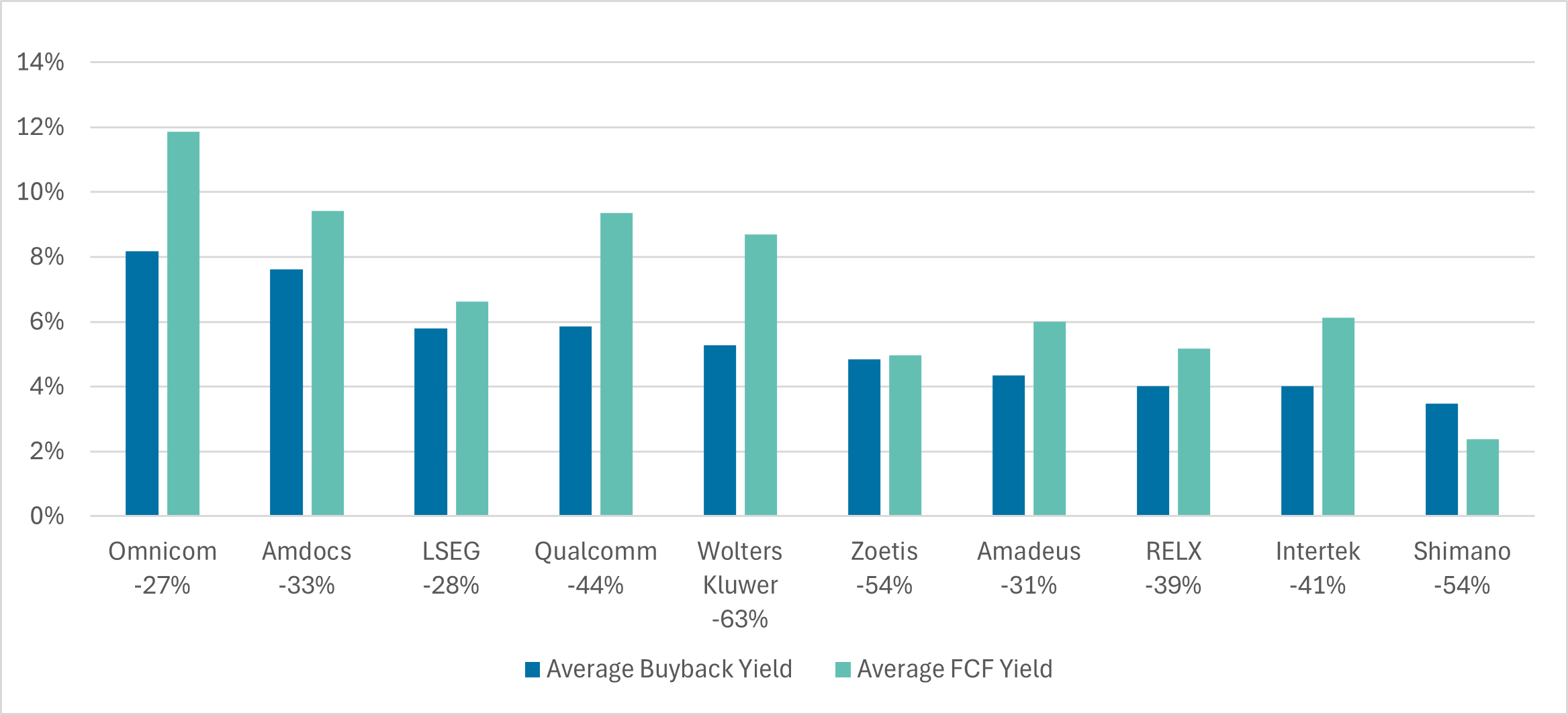
We can see how this is playing out for the portfolio by looking at buyback yields, i.e. how much of its own stock a company is buying compared to its total market value. The following chart shows the portfolio companies with the largest average buyback yield for FY25 and FY26E along with their average free cash flow yieldi and share price decline from peak in the past five years:
Free cash flow and buyback yields - With share price change from 5-year peak
Data from S&P CapIQ and Visible Alpha consensus.
A simple framework for prospective long term shareholder returns is:
Total Shareholder Return (TSR) =
Dividend Yield + Per Share Free Cash Flow Growth + Multiple Change
When a company buys back its own shares and cancels them, it reduces the number of shares in issue and therefore increases per share free cash flow growth. If the shares are purchased at the current share price, the percentage reduction in share count is the buyback yield. Free cash flow per share growth is the combination of underlying free cash flow growth and this reduction in share count.
Therefore:
TSR = Dividend Yield + Free Cash Flow Growth + Buyback Yield + Multiple Change
When the company’s share price declines but free cash flow continues to grow, astute management can use the excess cash flow to buy back shares. The buyback yield is much larger than it would have been before the shares declined, increasing prospective shareholder returns for remaining owners. High return on capital, asset-light companies that generate lots of excess cash flow are perfectly placed to do this.
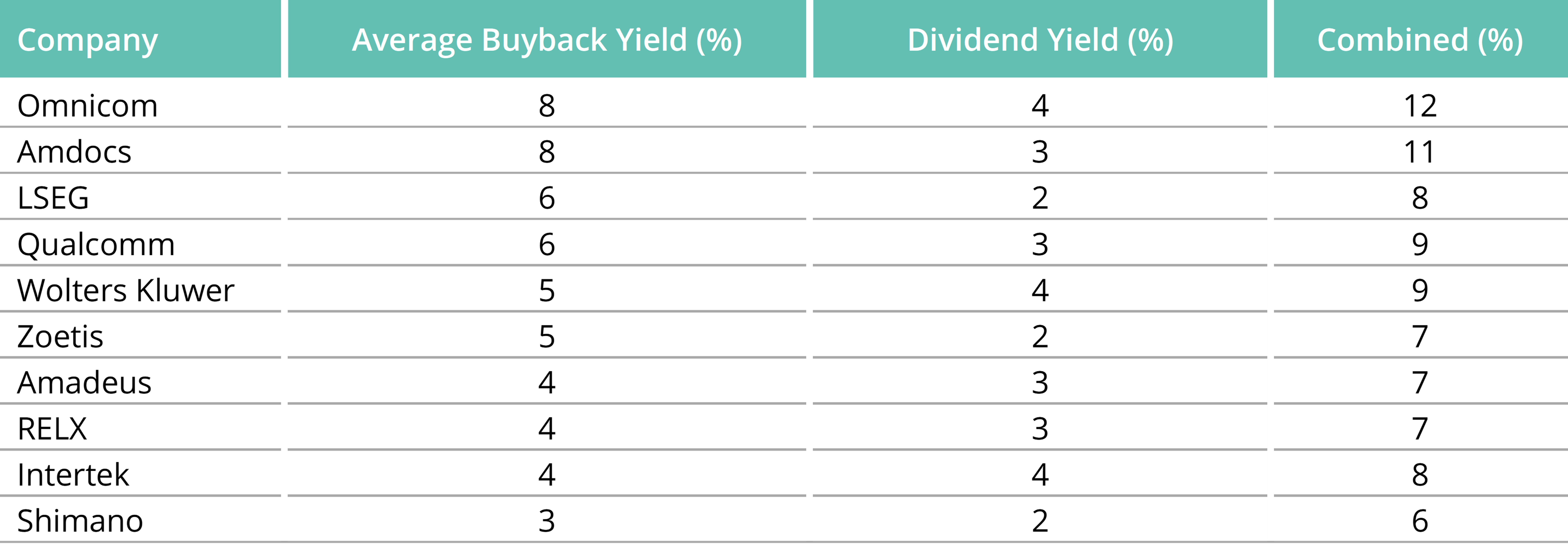
That these companies have suffered large share price declines from their recent peaks is undesirable but offers a margin of safety because of the contrast with positive underlying performance. The market’s fear is creating an attractive ‘floor’ that can be illustrated if we assume no free cash flow growth or valuation multiple re-rating. This is a conservative view, but is instructive:
Data from S&P CapIQ and Visible Alpha.
There is growth to add on top of this conservative floor, at least in the near term. The group of companies above delivered +9% growth in free cash flow per share in 2025 and is forecast to deliver +12% in 2026 according to Visible Alpha data, with the average of analyst forecasts for the next five years standing at +12% per annum. Analyst forecasts should, of course, be taken with a generous pinch of salt - their crystal ball is no better than ours - and the potential for disruption - whether from AI, geopolitics or the ordinary economic cycle - deserves to be taken seriously. The broader point, though, is that the near-immediate collapse in profitability implied by current market valuations is not what most analysts currently expect. Sentiment can change rapidly and if these companies continue to post positive fundamentals (as we expect), their multiples will likely follow suit.
Overall, this is a simple analysis that has limits and excludes the depth of thought we apply to other areas like assessments of competitive advantage. But in complex, noisy times it can be useful to strip things back and consider investing in simple terms.
At the fund level, the dividend yield stands at 3% and the buyback yield at 2%, and we expect free cash flow to grow at high single-digit rates over time - currently forecast at +9% per annum. Together, these components imply double-digit total returns even in the absence of any valuation re-rating. A tailwind from expanding multiples would of course be welcome, but it is not a requirement for delivering attractive returns from here. Market prices are doing a great deal of the work.
Set against this, the broader equity market tells a quite different story. Companies that have benefited most visibly from the AI and defence boom are, in many cases, trading on free cash flow yields of just 2-3% or less with inferior microeconomics, already pricing in a great deal of good news. The market as a whole sits at a free cash flow yield of 3.3%, with free cash flow growth forecast in the mid-single digits. Its dividend yield is 1.8% and buyback yield is a further 1.3%. Applying the same simple framework, this implies single-digit total returns at best, and that is before accounting for the risk of multiple contraction from already elevated levels. A market that has levitated through war, tariff uncertainty and rate anxiety is one that has, we think, borrowed heavily against the future.
The divergence between these two sets of numbers is not merely a point of academic interest. It represents a widening gap between a portfolio priced for pessimism and a market priced for optimism, and history suggests that gaps of this nature tend to close - often meaningfully - in symmetry with their forceful creation by a momentum-driven market. We remain focused on what we can control: the quality of the businesses we own, the prices we pay for them, and the patience to let fundamentals, rather than sentiment, drive long-term returns.
Ben Peters and Rob Hannaford
23 March 2026
Evenlode has developed a Glossary to assist investors to better understand commonly used terms.
Market data is sourced from S&P Capital IQ, Financial Express Analytics and Bloomberg unless otherwise stated.
This document is not intended as a recommendation to invest in any particular asset class, security, or strategy. The information provided is for information purposes only and should not be relied upon as a recommendation to buy or sell securities. Prospective investors should seek independent financial advice.
This document has been produced by Evenlode Investment Management Limited (‘Evenlode’). Every effort is taken to ensure the accuracy of the data used in this document, but no warranties are given.
Investment commentary represents the opinions of the Evenlode team at the time of writing and does not constitute investment advice. Where opinions are expressed, they are based on current market conditions, may differ from those of other investment professionals and are subject to change without notice. Any forecasts provided are subject t0 change and are not guaranteed.
Evenlode Global Dividend is a sub-fund of the Evenlode ICAV. Full details of the Evenlode Funds, including risk warnings, are published in the Evenlode Investment Funds Prospectus and the Evenlode Investment Funds Key Information Documents (KIDs) which are available on request and at www.evenlodeinvestment.com.
The Evenlode Funds are subject to normal stock market fluctuations and other risks inherent in such investments. The value of your investment and the income derived from it can go down as well as up, and you may not get back the money you invested. You should therefore regard your investment as long term. As a focused portfolio of between 30 and 50 investments, Evenlode Global Dividend may carry more risk than a fund spread over a larger number of stocks. The funds have the ability to invest in derivatives for the purposes of efficient portfolio management (techniques used by investment managers to manage a portfolio in a way that aims to improve returns, reduce risk, or manage costs, without significantly changing the overall investment strategy or risk profile), which may restrict gains in a rising market. Investments in overseas equities may be affected by changes in exchange rates, which could cause the value of your investment to increase or diminish.
Past financial performance is not a reliable indicator of future results. Fund performance figures are shown inclusive of any reinvested income and net of ongoing charges and portfolio transaction costs unless otherwise stated. The figures do not reflect any entry charge paid by individual investors. Tax treatment depends on individual circumstances and may change in the future.
Evenlode believes that delivering real, durable returns over the long term can be best achieved by integrating environmental, social and governance (ESG) factors into the risk management framework as this ensures that all long-term risks are monitored and managed on an ongoing basis. In addition to reviewing ESG factors when making investment decisions, Evenlode engages with portfolio companies on a range of ESG issues (for example greenhouse gas emission reduction). However, please note that the fund does not have a sustainability objective.
This document is neither directed to, nor intended for distribution or use by, any person or entity who is a citizen or resident of or located in any locality, state, country or jurisdiction where such distribution, publication, availability or use would be contrary to law or regulation. The sale of shares of the fund may be restricted in certain jurisdictions. In particular shares may not be offered or sold, directly or indirectly in the United States or to U.S. Persons, as is more fully described in the Fund's Prospectus.
The MSCI information may only be used for your internal use, may not be reproduced or redisseminated in any form and may not be used as a basis for or a component of any financial instruments or products or indices. None of the MSCI information is intended to constitute investment advice or a recommendation to make (or refrain from making) any kind of investment decision and may not be relied on as such. Historical data and analysis should not be taken as an indication or guarantee of any future performance analysis, forecast or prediction. The MSCI information is provided on an “as is” basis and the user of this information assumes the entire risk of any use made of this information. MSCI, each of its affiliates and each other person involved in or related to compiling, computing or creating any MSCI information (collectively, the “MSCI Parties”) expressly disclaims all warranties (including, without limitation, any warranties of originality, accuracy, completeness, timeliness, non-infringement, merchantability and fitness for a particular purpose) with respect to this information. Without limiting any of the foregoing, in no event shall any MSCI Party have any liability for any direct, indirect, special, incidental, punitive, consequential (including, without limitation, lost profits) or any other damages. (www.msci.com).
EAA Fund Global Equity Income Sector – © Morningstar 2025. All rights reserved. The information contained herein: (1) is proprietary to Morningstar and/or its content providers; (2) may not be copied, adapted or distributed; and (3) is not warranted to be accurate, complete or timely. Neither Morningstar nor its content providers are responsible for any damages or losses arising from any use of this information, except where such damages or losses cannot be limited or excluded by law in your jurisdiction.
Evenlode is a trading brand of Evenlode Investment Management Limited. Authorised and regulated by the Financial Conduct Authority, No. 767844. Investment Fund Services Limited is authorised and regulated by the Financial Conduct Authority, No. 464193.
Spring Capital Partners Limited is an Appointed Representative of Robert Quinn Advisory LLP, which is authorised and regulated by the Financial Conduct Authority, with FRN 548030. Spring Capital Partners GmbH and Spring Capital Partners AB are tied agents within the meaning of Article 29 (3) of Directive 2014/65/EU (“MiFID II” as implemented in the respective national legislation) of Allington Investment Advisors GmbH, Kaiser-Friedrich-Promenade 127, 61348 Bad Homburg v.d.H., Germany, which is authorised and regulated by the German Bundesanstalt für Finanzdienstleistungsaufsicht (BaFin) with BaFin-ID: 10158575.
The Tied Agents are entered in the public register of tied agents held by BaFin. Within the scope of providing financial services (“investment brokerage” within the meaning of Annex I A (1) MiFID II as implemented in the respective national legislation by promotion of the potential investor's willingness to enter into a transaction but excluding the reception and transmission of orders in relation to one or more financial instruments), the Tied Agents act exclusively on behalf and for the account of Allington Investment Advisors GmbH and undertake to exclusively distribute funds. The information provided by the Tied Agents is intended for informational purposes only and does not represent an offer to purchase or sell financial instruments. All information is provided without any guarantee. This information neither represents any investment / legal / tax advice, nor any recommendation. The Tied Agents point out that every investment decision should be made after consulting an advisor. The information is intended exclusively for professional clients within the meaning of Annex II MiFID II. The information provided may not be copied or further distributed to third parties without the prior consent of Allington Investment Advisors GmbH. The information may not be given to persons or companies that do not have their ordinary residence or domicile in the countries in which Allington Investment Advisors GmbH is authorised to provide financial services. In particular, the information may not be made available to US citizens or persons residing in the USA.
The Fund has appointed as Swiss Representative Waystone Fund Services SA, Av. Villamont 17, 1005 Lausanne, Switzerland, Tel: +41 21 311 17 77, email: Switzerland@ waystone.com. The Fund’s Swiss paying agent is Banque Cantonale de Genève. The Prospectus, the Key Investor Information Documents, the Instrument of Incorporation as well as the annual and semi-annual reports may be obtained free of charge from the Swiss Representative in Lausanne. In respect of the Shares distributed in or from Switzerland, the place of performance and jurisdiction is at the registered office of the Swiss Representative. The issue and redemption prices are published at each issue and redemption on www.fundinfo.com. Evenlode Investment Management Limited is authorised and regulated by the Financial Conduct Authority, No. 767844. The Evenlode Global Dividend Fund is authorised and regulated in the Republic of Ireland by the Central Bank of Ireland.
Footnotes
-
Free cash flow yield - Free Cash Flow (FCF) per share divided by the current share price. A higher free cash flow yield implies a company is generating more cash that could be paid out as dividends and to reinvest into growth of the business.