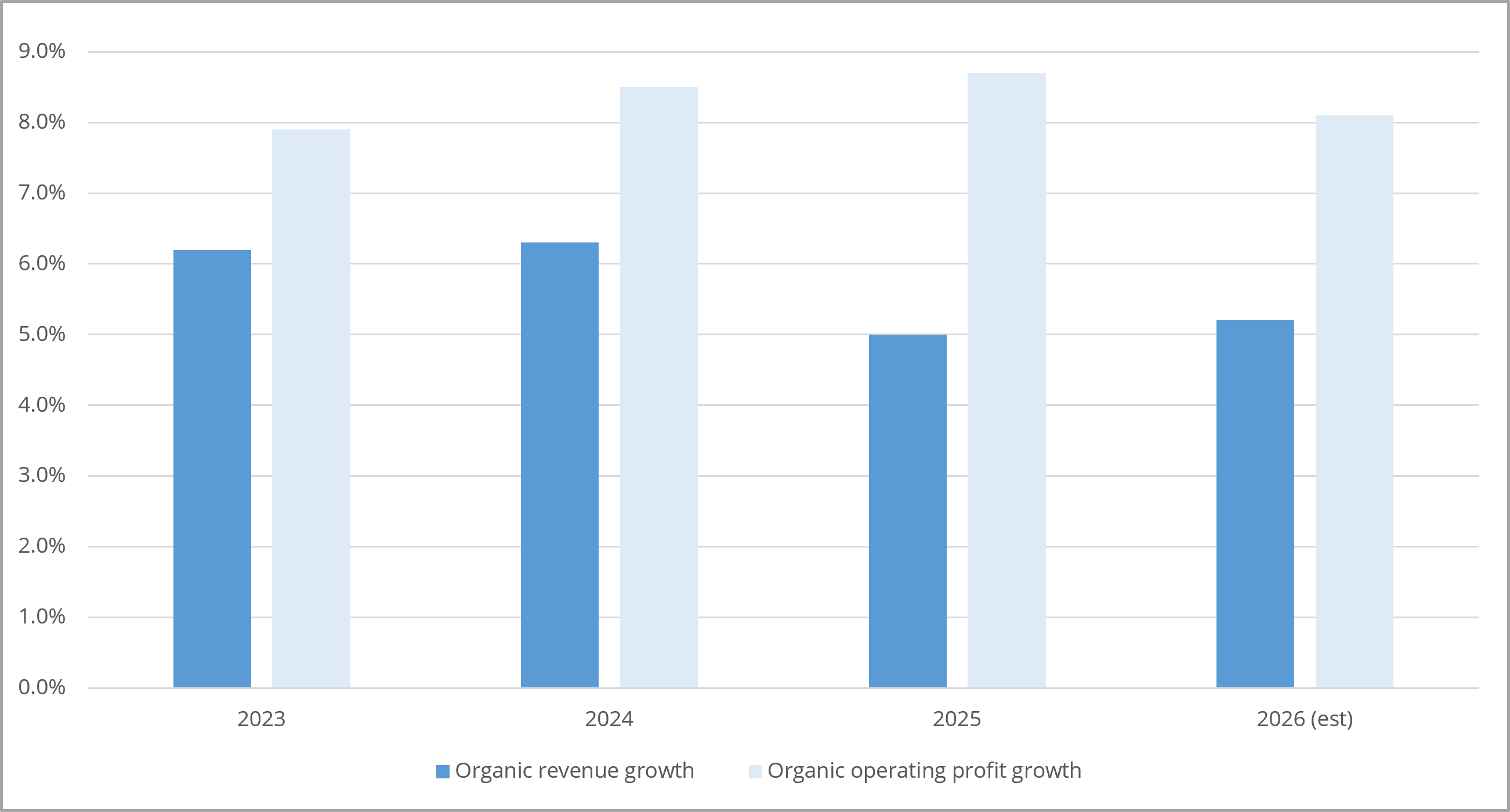
Interim results season came to an end in August. Despite a difficult geopolitical backdrop, aggregate full year forecastsi for the portfolio are very similar to where they stood at the start of the year: +5% organic revenue growthii, +8% organic operating profit growth, and double-digit earnings per shareiii growth. All holdings are expected to grow organic operating profit for the full year.
The below chart shows the organic revenue and operating profit growth for portfolio holdingsiv over the last three years and the expectation for growth in 2026.
Source: Evenlode, August 2026.
Fundamentals are, therefore, robust. It has though so far been a frustrating year for the fund’s total return – up only +2.2% year-to-datev with the good fundamental progress of the portfolio companies offset by a continued valuation de-rating.
Though I’ve felt like something of a stuck record on the topic over recent months, the unusually attractive valuation of the portfolio bears reiterating. The free cash flowvi valuation is as good as it was both in IFSL Evenlode Income’s early days in the 2009-2011 period, and in the depths of the Covid sell-off in 2020. A remarkable fact given how buoyant sentiment is toward other areas of the UK market (banks and resources stocks) and the global market (the AI capex trade).
The fund’s free cash flow yieldvii stands at 6.0% for this year and 7.0% for next. To help frame the quantum of the valuation headwind over recent months, to return to the 4.5% free cash flow yield that the portfolio traded on three years ago, IFSL Evenlode Income’s unit price would need to be more than +33% higher than it is today.
The fundamental algorithm
Looking ahead, we think the prospects for the fund to compound at an attractive double-digit rate are very good. If we think about the fundamental algorithm for the fund (i.e. assuming no change in valuations), the portfolio’s dividend yieldviii is around 3% and the buyback yieldix is over 2%. These two elements add up to a current annual shareholder yield of over 5%, even if earnings don’t grow. This shareholder yield is sustainable given that it is funded by a 6% free cash flow yield. On top of this, we think the portfolio is very well set to deliver profit growth (before the impact of buy-backs) in the +5-10% range over time. Any valuation re-rating back towards historical averages would be further upside to this fundamental growth algorithm.
The opportunity in long-term quality compounders
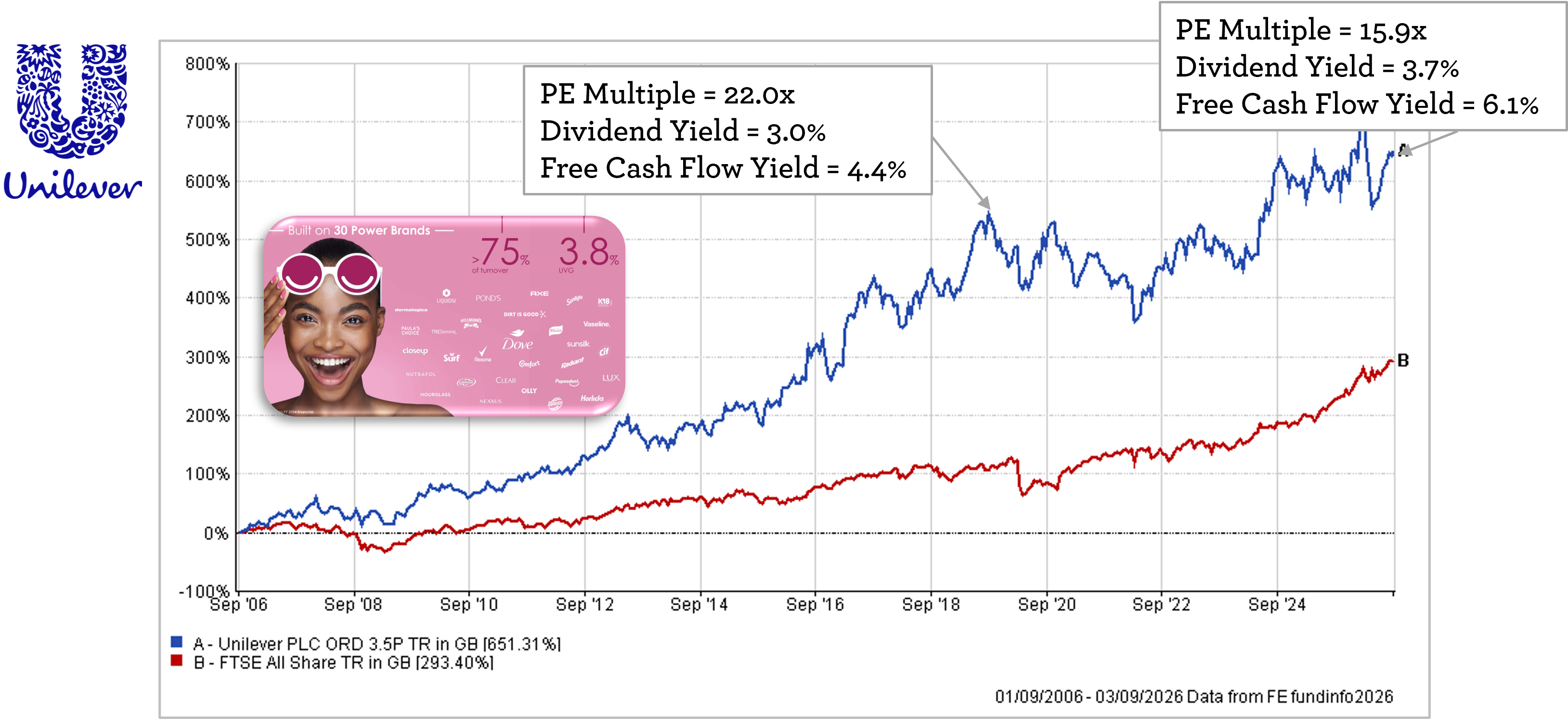
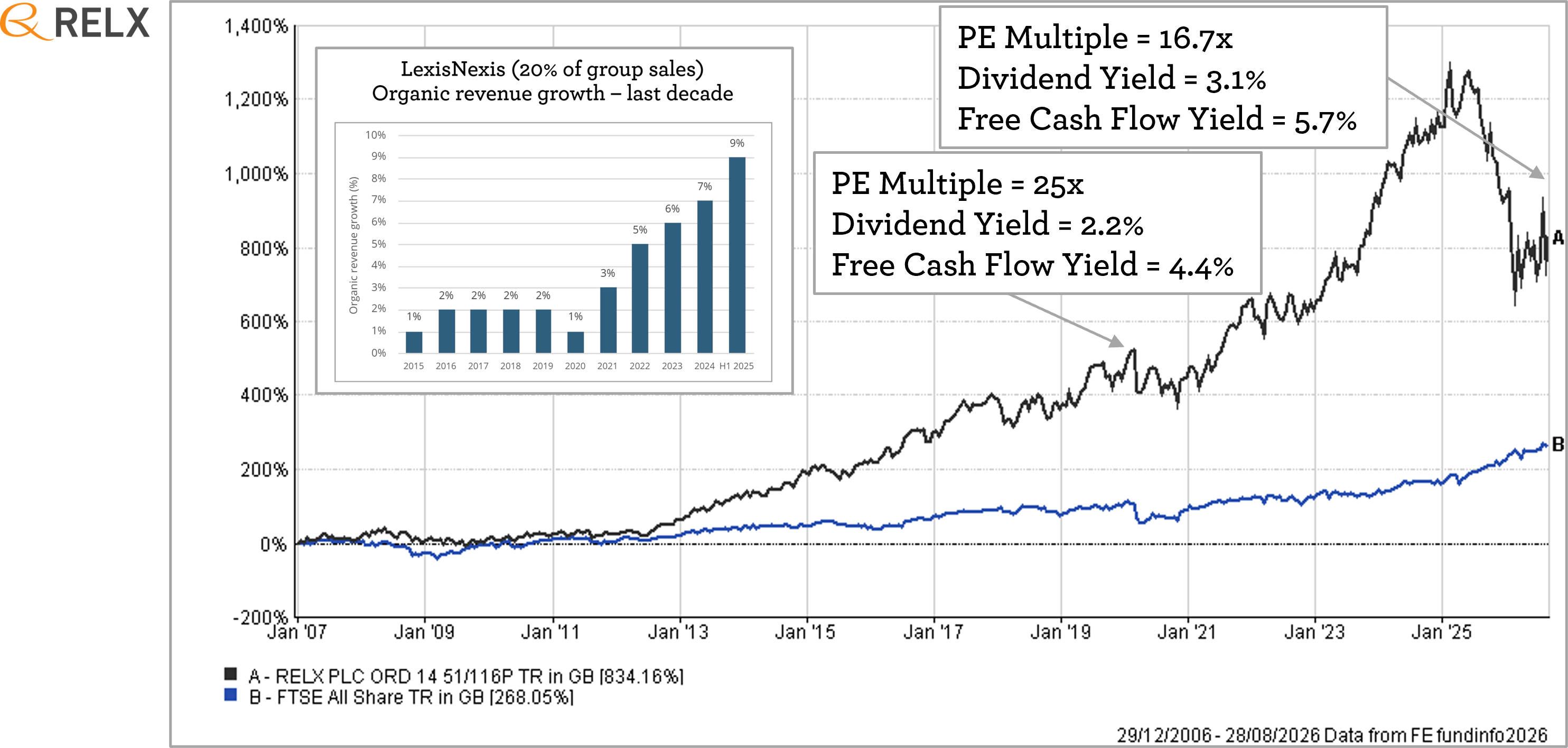
The fund’s two largest holdings – Unilever and RELX – are a good couple of case studies to highlight the valuation de-rating we have seen across the portfolio over the last few years.
Source: FE fundinfo, Evenlode, 1 September 2006 to 3 September 2026.
See below for definitions.x
Unilever is currently the fund’s largest holding. The chart above highlights the extent of the de-rating of Unilever shares over recent years (very similar in quantum to the portfolio as a whole – moving from a free cash flow yield of 4.4% at the beginning of the decade to 6.1% today).
Unilever is a well-invested, repeat-purchase business and one of the best placed consumer goods companies globally. Portfolio evolution over the last few years – which will culminate in the spin-offx of the foods division early next year – leaves the business as a faster-growing, higher-margin business centred around the personal care, beauty and well-being categories. More than 75% of Unilever’s revenue is now generated from its global power brands (Dove, Vaseline etc.), and nearly 60% of revenue is generated from its fast-growing emerging market presence (including 17% of revenue from India following the spin-off of the foods business).
Even without any improvement in the valuation, the potential for double-digit fundamental returns is clear – steady profit growth combined by healthy dividends and buy-backs, all backed by an extremely defensive cash-flow stream.
Despite a challenging first half for consumer sentiment and input cost inflation, Unilever is trading very well, with organic sales up +5.8% in the second quarter and full-year guidancexi raised for the full year. Guidance was raised despite management baking in an assumption that oil will average $115 dollars per barrel for the rest of the year.
Source: FE fundinfo, Evenlode, 29 December 2006 to 28 August 2026.
RELX is currently the fund’s second largest holding. The chart above is a reminder of the de-rating that RELX has experienced over the last five years (as with Unilever, very similar to the overall de-rating of the portfolio – from a free cash flow yield of 4.4% to 5.7% over the last five years).
We continue to view RELX as an incremental beneficiary of generative AI. We won’t restate the reasons why here as we have written about them extensively in previous investment views this year, but interim results were a clear demonstration that RELX’s front-footedness in harnessing generative AI technology is translating into tangible value for both RELX’s clients and financial results. For the first half, organic revenue grew at +7% and earnings per share grew at +11%.
As with Unilever, and many other positions in the portfolio, RELX’s free cash flow generation is highly repeat-purchase in nature - a very desirable through-cycle characteristic.
New holdings
More generally, we are seeing a great range of opportunities across our universe of competitively advantaged, high return-on-capital, UK-listed companies - from UK-based global market leaders to domestic market leaders, from consumer-facing to business-to-business franchises, and across the market capitalisation spectrum.
We have now fully exited the fund’s holdings in Rotork and Intertek, following their recommended takeover approaches, and used a portion of the proceeds to initiate four new positions – each approximately 1% of the fund and with room for us to build further.
I will finish this investment view by briefly discussing these new holdingsxii.
DiscoverIE
Dividend Yield 1.9%
Free Cash Flow Yield 6.4%
DiscoverIE is a well-managed, return-on-capital focused, niche industrial compounder. The company is a portfolio of around 30 operating companies that specialise in mission-critical, highly bespoke electrical components. DiscoverIE’s team of engineers work very closely with customers on the design process. Almost all components are sole sourced, they represent a very small portion of the total value of the end products in which they sit, and DiscoverIE retains the intellectual property. Once specified in, these components are manufactured and supplied throughout the life of each product's production, generating a high level (>85%) of revenue recurrence from sticky, long-term customer relationships.
Management has focused deliberately on five structural-growth markets that make up roughly 80% of sales: industrial automation and connectivity, security and defence, renewables, electrification of transportation, and medical. End-product examples include components for MRI scanners, wind turbine systems, robotic arms, airport scanners and surveillance drones.
The company has grown earnings per share on average by +14% over the last decade, through a combination of organic growth and bolt-on acquisition, and management see a similar level of growth potential over coming years. Revenue growth, though, slowed in the post-Covid period – which has led to a significant valuation de-rating in the company’s shares. Operating momentum is now improving, with group order growth rising by more than +30% year-on-year in the latest quarter - driven by broad underlying demand from its diversified end markets.
We think the free cash flow yield of over 6% represents an interesting entry point for this high-quality company that offers plenty of cash generative growth potential.
Avon Technologies
Dividend Yield 1.6%
Free Cash Flow Yield 6.4%
Avon Technologies is a global market leader in mission-critical protective equipment for the military and first responders. The company was founded in Wiltshire in 1885 and was a key supplier and manufacturer of gas masks during the Second World War.
Today, the business focuses on respiratory protection (CBRN masks, filters, powered systems and underwater rebreathers) and head protection (ballistic and impact helmets). The barriers to entry are considerable with customer embeddedness, intellectual property and technological excellence all important factors. In advanced respiratory protection, the company has over 90% market share in North America, and more than 70% globally. Avon offers attractive growth potential both within its core US and UK markets, and through expansion opportunities with other NATO and international customers.
A new senior executive team has been in place for the last three years – several were previously part of the Ultra Electronics management team. They are very focused on ROIC (return-on-invested capital) and have made significant improvements to operational and commercial execution. This is beginning to show through in the financials, with ROIC having improved from 14% in 2024 to 21% in the first half of 2026.
As with DiscoverIE, we think a starting free cash flow yield of more than 6% is very attractive for the quality and growth prospects at Avon.
Greggs
Dividend Yield 4.1%
Free Cash Flow Yield 10.9%
Greggs is a leading UK food-on-the-go retailer and an old friend to IFSL Evenlode Income – having been a holding for several years back in the 2010s. We have been following the investment case since exit and have reinitiated a position over recent weeks for three key reasons.
The first reason is we believe management are adapting well to changes in their market, including variable weather patterns and changing diet preferences. The second is that management have made some important tweaks to their store opening strategy, giving us confidence in the more than 25% return on investment that the company generates within three years of a store opening. This has involved a range of simple changes. One example is focusing drive-through sites on industrial estates where returns are higher.
The third reason is the phenomenal free cash flow stream – generated from the aggregation of many low-ticket, repeat-purchase items – including more than one million sausage rolls sold every day. Greggs is also coming to the end of a major capital investment programme that has upgraded and expanded its vertical integrated manufacturing and supply chain facilities – an important factor for its very strong competitive position. The company now has the capacity in place to grow to its targeted 3,500 store footprint over the next eight years, without any further material capital investment. This is leading to a significant step-up in free cash flow generation. Management are expecting to return almost all of the company’s 10% free cash flow yield to investors via a combination of dividends, special dividendsxiii and share buy-backs. Meanwhile, the operating business should be capable of producing steady profit growth – driven by in-store sales growth and new store openings.
XPS Pensions
Dividend Yield 4.9%
Free Cash Flow Yield 8.2%
XPS is a domestic market leader in the niche and esoteric world of pension consultancy and administration. Barriers to entry are high, due to the requirement for very specific domain knowledge and expertise, and client embeddedness. The hassle and risk of changing provider is significant. These factors lead to approximately 90% revenue recurrence. Earnings consistently convert to cash generation, and the current free cash flow yield is at a highly compelling level.
XPS is a well-invested and client-focused leader, which we have confirmed via expert calls with pension trustees. Of the approximately 60 in-house corporate schemes that have come to market over the last five years, XPS has won approximately half of the outsourced contracts. Growth prospects look very well set over coming years thanks to inflation-linked contracts, changing regulations, outsourcing trends and the potential for market share gains. Longer-term, the company is pursuing a bolt-on strategy to ‘follow the pension member’ into the adjacent world of insurance consulting, which will gradually diversify the business.
Following the free cash flow
All four of these companies possess the usual Evenlode features: durable competitive advantages and the ability to grow in a capital efficient way. They also have good growth opportunities, are generating significant levels of free cash flow, and bring interesting diversification to the portfolio.
In addition, we have a good number of other companies on our watchlist with similar characteristics, giving us plenty of other options to broaden the portfolio further - if and when we think it makes sense.
Hugh, Chris M., Ben P, Leon and the Evenlode team
16 September 2026
Important information
Evenlode has developed a Glossary to assist investors to better understand commonly used terms.
Market data is sourced from S&P Capital IQ, Financial Express Analytics and Bloomberg unless otherwise stated.
This document is not intended as a recommendation to invest in any particular asset class, security, or strategy. The information provided is for information purposes only and should not be relied upon as a recommendation to buy or sell securities. Prospective investors should seek independent financial advice.
This document has been produced by Evenlode Investment Management Limited (‘Evenlode’). Every effort is taken to ensure the accuracy of the data used in this document, but no warranties are given.
Investment commentary represents the opinions of the Evenlode team at the time of writing and does not constitute investment advice. Where opinions are expressed, they are based on current market conditions, may differ from those of other investment professionals and are subject to change without notice. Any forecasts provided are subject to change and are not guaranteed.
IFSL Evenlode Income is a sub-fund of the IFSL Evenlode Investment Funds ICVC. Full details of the Evenlode Funds, including risk warnings, are published in the IFSL Evenlode Investment Funds Prospectus and the IFSL Evenlode Investment Funds Key Investor Information Documents (KIIDs) which are available on request and at www.evenlodeinvestment.com.
The IFSL Evenlode Investment Funds are subject to normal stock market fluctuations and other risks inherent in such investments. The value of your investment and the income derived from it can go down as well as up, and you may not get back the money you invested. You should therefore regard your investment as long term.
The Evenlode philosophy and process creates a bias towards companies that meet our quantitative and qualitative requirements. As a result, the fund may have material differences in exposure in terms of style factors, industry sectors and geographies to the wider equities market and comparator benchmark. Over the short-term this may result in material underperformance in certain market conditions.
As a focused portfolio of between 30 and 50 investments, IFSL Evenlode Income may carry more risk than a fund spread over a larger number of stocks. The funds have the ability to invest in derivatives for the purposes of efficient portfolio management (techniques used by investment managers to manage a portfolio in a way that aims to improve returns, reduce risk, or manage costs, without significantly changing the overall investment strategy or risk profile), which may restrict gains in a rising market. Investments in overseas equities may be affected by changes in exchange rates, which could cause the value of your investment to increase or diminish.
Past financial performance is not a reliable indicator of future results. Fund performance figures are shown inclusive of any reinvested income and net of ongoing charges and portfolio transaction costs unless otherwise stated. The figures do not reflect any entry charge paid by individual investors. Tax treatment depends on individual circumstances and may change in the future.
Evenlode believes that delivering real, durable returns over the long term can be best achieved by integrating environmental, social and governance (ESG) factors into the risk management framework as this ensures that all long-term risks are monitored and managed on an ongoing basis. In addition to reviewing ESG factors when making investment decisions, Evenlode engages with portfolio companies on a range of ESG issues (for example greenhouse gas emission reduction). However, please note that the fund does not have a sustainability objective.
This document is neither directed to, nor intended for distribution or use by, any person or entity who is a citizen or resident of or located in any locality, state, country or jurisdiction where such distribution, publication, availability or use would be contrary to law or regulation. The sale of shares of the fund may be restricted in certain jurisdictions. In particular shares may not be offered or sold, directly or indirectly in the United States or to U.S. Persons, as is more fully described in the Fund's Prospectus.
FTSE® is a trademark of the relevant London Stock Exchange Group plc (“LSE Group”) companies and is used under licence. FTSE Russell is a trading name of certain LSE Group companies. All rights in FTSE Russell indices and data vest in the relevant LSE Group company. Neither LSE Group nor its licensors accept any liability for errors or omissions in the indices or data, and no reliance should be placed on this information. Redistribution of LSE Group data is prohibited without prior written consent. LSE Group does not promote, sponsor, or endorse the content of this communication.
Evenlode is a trading brand of Evenlode Investment Management Limited. Authorised and regulated by the Financial Conduct Authority, No. 767844. Investment Fund Services Limited (IFSL) is authorised and regulated by the Financial Conduct Authority, No. 464193.
Footnotes
-
Based on analysts’ forward-looking forecasts.
-
Organic revenue growth – The percentage increase in sales generated from a company’s existing resources and operations. It excludes growth attributable to mergers and acquisitions and foreign exchange movements.
-
Earnings per Share (EPS) – A measure of company profitability, calculated by dividing a company’s profit by the number of shares in issue.
-
IFSL Evenlode Income Fund.
-
Source: Financial Express. Total Return, bid to bid (B Acc GBP class). 31 December 2025 to 14 September 2026.
-
Free cash flow (FCF) – A measure of how much cash a company can generate over and above normal operating expenses and capital expenditure. The more FCF a company has, the more it can allocate to dividend payments and growth opportunities.
-
FCF yield - FCF per share divided by the current share price. A higher FCF yield implies a company is generating more cash that could be paid out as dividends and to reinvest into growth of the business.
-
Dividend yield – calculated by dividing the dividend per share by the current share price.
-
Buyback yield – A measure of how much cash a company returns to shareholders by buying back its own shares. It is expressed as a percentage of the company’s market value. Share buybacks reduce the number of shares in issue, which can increase earnings per share and each remaining shareholder’s ownership stake in the business.
-
Spin-off – When a company separates one of its divisions or businesses into a new standalone company. Existing shareholders typically receive shares in the new company in proportion to their existing shareholding.
-
Full year guidance - A company's forecast of how it expects to perform financially over its current financial year. This may include expectations for revenue, profit, earnings or cash flow. Investors often compare actual results with guidance to assess whether a company has performed in line with expectations.
-
Dividend Yield and Free Cash Flow Yield figures quoted for new holdings are forward looking forecasts.
-
Special dividends – A one-off dividend paid by a company in addition to its regular dividends. Special dividends are typically paid when a company has generated excess cash.